

Last Updated on 16/07/2026 by owen_2023
The Complete Guide to Commercial PV Solar
As energy costs continue to rise and businesses look for ways to reduce their carbon footprint, commercial PV solar has become one of the most effective long-term investments available. By generating renewable electricity on-site, businesses can reduce operating costs, improve energy independence and demonstrate a commitment to sustainability. However, before investing in a commercial solar installation, it’s important to understand how these systems work, how much energy they can produce and whether your premises are suitable.
This guide explains everything you need to know about commercial PV solar, from roof suitability and system sizing to inverters, battery storage and electric vehicle charging.
What Is Commercial PV Solar?
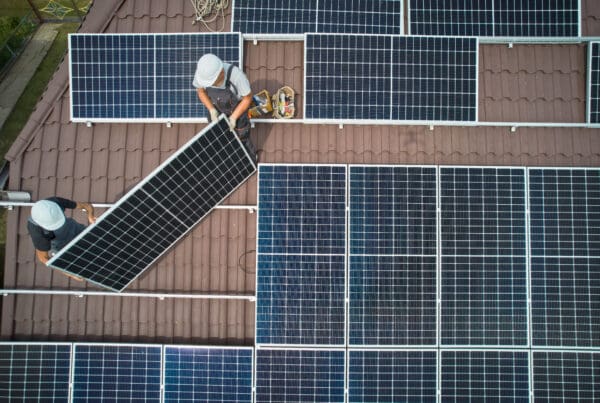
Commercial PV solar (photovoltaic solar) uses solar panels to convert sunlight into electricity for business premises. Unlike domestic systems, commercial PV solar installations are designed to support larger electricity demands, making them suitable for offices, warehouses, factories, retail premises, farms and industrial sites.
The electricity generated can be used immediately within the business, helping to reduce reliance on grid electricity. Any excess energy can often be exported to the grid or diverted to other applications, such as electric vehicle charging.
Is Your Building Suitable for Commercial PV Solar?
One of the first considerations when installing commercial PV solar is whether your site has sufficient roof or ground space. Fortunately, most commercial buildings have suitable areas for solar panels, particularly warehouses, manufacturing facilities and office buildings with large roof surfaces.
Several factors influence how much electricity your system can generate.
- Roof Orientation
- The direction your roof faces has a significant impact on solar performance.
- For maximum electricity generation, the ideal roof orientation is:
- South-facing
- South-east or south-west
- East or west
South-facing roofs receive the greatest amount of sunlight throughout the day, producing the highest annual output.
However, east and west-facing roofs can still deliver excellent results.
East-facing solar panels generate more electricity during the morning, while west-facing panels capture more solar energy during the afternoon. This can actually benefit businesses whose peak electricity demand occurs at specific times of day.
Does Roof Pitch Matter?
Yes—but perhaps not as much as many people think. The ideal roof pitch for commercial PV solar installations in Ireland is between 30 and 40 degrees, allowing panels to capture the maximum amount of sunlight throughout the year.
That said, solar panels can be successfully installed on most roof types. Flat roofs can accommodate commercial PV solar using specially designed mounting systems that position the panels at the optimal angle. Ground-mounted systems are also an excellent solution where sufficient land is available.
Understanding Commercial PV Solar Output
Every solar panel has a power rating, usually expressed in kilowatts (kW). This represents the panel’s maximum output under ideal conditions.
A simple way to estimate daily electricity generation is:
Panel Rating (kW) × Hours of Daylight = Daily Electricity Generated (kWh)
Because daylight hours vary throughout the year, installers generally use annual averages when estimating production.
As a guide:
Every 1 kW of installed commercial PV solar can generate up to 900 kWh of electricity each year.
A 100 kW system can generate approximately 90,000 kWh annually.
A 250 kW system could produce around 225,000 kWh annually.
A 1 MW commercial PV solar installation can generate up to 900,000 kWh every year.
Actual output will depend on factors such as location, roof orientation, shading and weather conditions, but these figures provide a useful benchmark during the planning stage.
Choosing the Right System Size
Not every business requires the same size installation. Large manufacturing plants and distribution centres may have enough roof space to accommodate systems approaching 1 MW, while many commercial businesses install systems between 50 kW and 300 kW.
The right system size depends on several factors, including:
- Available roof or ground space
- Current electricity consumption
- Future energy requirements
- Investment budget
- Available grid capacity
A professional site assessment can help determine the most appropriate solution without overspending on unnecessary capacity.
The Importance of Solar Inverters
While solar panels receive most of the attention, the inverter is one of the most important components of any commercial PV solar system. Solar panels generate electricity as direct current (DC). Most commercial buildings, however, operate using alternating current (AC). The inverter converts DC electricity into AC electricity so it can safely power machinery, lighting, computers and other business equipment.
Modern inverters also provide much more than simple power conversion.
Many now function as intelligent energy management systems, allowing businesses to:
- Monitor electricity generation
- Optimise energy usage
- Export surplus electricity to the grid
- Divert excess power to hot water systems
- Integrate with electric vehicle charging infrastructure
This allows businesses to maximise the value of every unit of electricity generated.
Integrating Electric Vehicle Charging
As more organisations transition to electric vehicle fleets, commercial PV solar offers an ideal opportunity to reduce transport costs. Electric vehicle chargers can be integrated directly into the solar installation, allowing businesses to charge company vehicles using renewable electricity generated on-site.
Some organisations also choose to install solar carports, combining sheltered parking with clean energy generation. These highly visible installations demonstrate a company’s commitment to sustainability while making productive use of available space.
Should Your Business Invest in Battery Storage?
Battery storage is often one of the biggest questions businesses ask when considering commercial PV solar. The answer depends on how your business uses electricity.
Most commercial premises consume most of their electricity during normal working hours—the same period when solar panels are generating the most power. Because of this, many businesses can use most of their solar electricity immediately, reducing the need for battery storage.
Where excess electricity is generated, businesses may choose to:
- Export electricity to the grid
- Charge electric vehicles
- Power other on-site equipment
Battery technology continues to improve, and as installation costs fall and government incentives evolve, battery storage is likely to become an increasingly attractive option for commercial businesses.
Why a Professional Solar Assessment Matters
Every commercial property is different. Factors such as roof structure, electricity demand, available space, future expansion plans and budget all influence the ideal system design. A professional desk-based or on-site survey removes the guesswork by assessing:
- Roof suitability
- Available installation area
- Current electricity consumption
- Potential energy generation
- Return on investment
- Recommended system size
This ensures businesses invest in a commercial PV solar system that delivers the greatest financial and environmental benefit.
Investing in commercial PV solar is about more than reducing electricity bills. It’s an opportunity to improve energy resilience, lower carbon emissions and future-proof your business against rising energy costs.
Whether you’re considering a modest 50 kW installation or a large-scale megawatt system, the key to success is choosing the right design for your business’s energy needs. With the right assessment, equipment and installation partner, commercial PV solar can deliver reliable, renewable electricity for decades while supporting your organisation’s sustainability goals and long-term financial performance.
The Solarstream in-house team brings an expert skills set of knowledge to all the solar projects we get involved in. This includes full project management, technical expertise to supporting our customers grant applications right down to the highest quality products we install.


 All Rights Reserved |